 There is a well-known and well stablished concept of evolution. And while this gem of Scientific proof reveals the nature of life, it does not explain, neither it aims to show the changes beneath the layers of a thought. The brain has evolved throughout millions of years. Certain parts of the brain, of course, either have grown or have been created to adapt to the needs of life. And if you followed well these lines of discernment you may have already questioned: What are the needs of today’s life? Watching the joker may make you wonder that all that exclusive drama played on the big screen is a fantasy of the movie producer. And all that play is nothing but an opposite description of life. However, it is not the actions in that movie that play the important role in this analysis, but specific lines and the process of Joker’s thoughts that are correlated to ordinary lives. Going back into how a thought is form Science is unprecise when it comes to thinking. Yes, you can point out which regions of the brain are utilized for this process, but when it comes to negative or positive thinking the odds of creating a bad or good thought are certainly connected to data, psychology, and the unknown evolution of thought. So, what are the needs of today’s life? Well, we can start by observing the following charts.  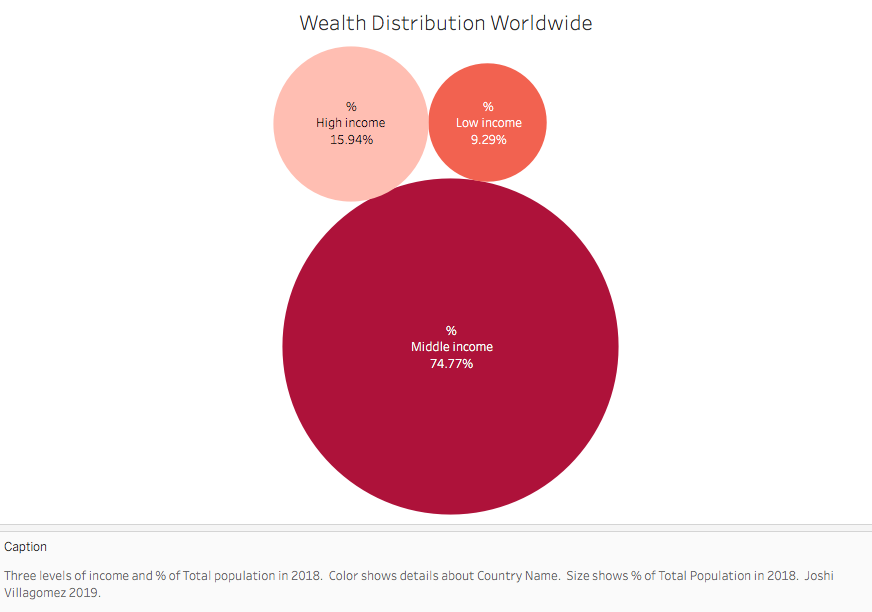 Social issues begin with inequality of wealth. If we measure the probability of seeing a low-income individual committing a crime, the changes will start by creating a group that has 705,507,716 individuals or 9.29% in part of the worldwide population. Now, measuring the intentions versus the actions is quite full of complexities. And while the purpose of this analysis is not to label wealth inequality as the evil of all problems it is indeed an influencer in thought creation. You know, thinking moves fast from a perceptional thought to a convoluted action. The reason perhaps why philosophers and scientist are never clear or easy to be understood. But the thing is, that most actions mirror societies behavior, and not personal merits. Therefore, while the specific thought is created by the impulse of mobility the road in which the thoughts travel was already built. If building a thought requires of an input, then, are we shaping in the right direction the future generations? I don’t leave this question to determine how the world is doing, but to conclude that owned actions might be shaping the thoughts of others. Data Source: https://data.worldbank.org/indicator/sp.pop.totl Since when thoughts have revolutionized from being a tragedy to become a comedy?
1 Comment
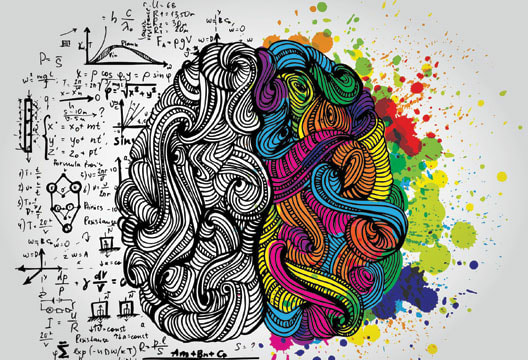 Unlike other sciences, the study of the brain brings magnificence to that natural connections of the physiology and our thinking. To chemistry and our thinking. To anatomy and our thinking. To physics and our thinking. And so on. Neuroscience, a science that studies the functional mechanisms of the brain is so magnifique that stirs my thinking every time I learn something new. While there are countless wonders about the brain, the existent information overwhelms anyone. And I must say than rather than intimidating, neuroscience is so cool. As we learn a science or subject in life, our need to apply the skills-learned drive us to conquer the environment in which we live. That means that if we learn how to read or write, we might end up becoming writers or literature judges. As it might always be the case, it is true that a specific learning makes feel awesome. Now imagine learning about frontal lobes, the occipital lobes, the amygdala or any other region of the brain that we use regularly in life. Wouldn’t feel nerdy to stop and recognize the senses your utilizing this moment, but at the same time would be so cool? A subject like neuroscience gives us more than just information. It provokes our mind to explore new things relevant to the subject and gives more reasons to learn than to quit. Science in general is amazing, but neuroscience is so cool! Don’t feel intimidated learning more about the old brain!  While ethical concerns surged from experiments like this, think Neuro-emotions while you read the article.
In January 11–18, 2012 an experiment involving emotional response was conducted by a global behemoth. Facebook, one of the largest social websites, implement a series of News Feed manipulation where the user would only see either positive or negative post. The purpose of the controlled experiment was to collect data upon a responsive reaction to the triggered post. Two variables, Positive and Negative, were the center of the experiment that once the data was collected it would support the claims of emotional contagion. Data was collected during a week were roughly ∼155,000 users participated without their knowledge. The ethical question arises after Facebook was questioned if the participants were asked for consent and the answer was avoided by a general statement were Facebook claims that users acknowledge any Facebook’s policies by signing in into their accounts. Users naturally responded to the controlled experiment that lately was published as an experiment under the spectrum of psychological and cognitive sciences. The Experimental evidence of massive-scale emotional contagion through social networks document provides significant information that could be used for scientific purposes, however in the ambit of ethical measures, collecting data without the knowledge of the users is an advantageous move in the world of data mining. The nature of such experiment rest upon an unethical equilibrium where no consent is retrieved from the participants. As a student of science, I am aware that the main key for a successful experiment is concentrated in the details of the matter. That means, that knowing age, gender and other characteristics of the user was essentially important to penetrate cognitive boundaries. It is utterly unethical this violation of freedom in cognitive response. No consent was given and the resulting data was analyzed. As Frank Buytendijk portrays in Power, reach of analytics pose new ethical dilemmas the ultimate use of the collected data contradicts the ethical schemas of a free world. In this case, data is collected from a distinctive angle; however, it could be utilized strategically for Facebook’s gain. Buytendijk mentions in his article, “Analytics today are interactive and iterative. Analyzing data is… it’s explorative in nature.” And the nature of social network as Facebook is to find the profitable dispositions of his company. This approach, as mentioned, differs from many others that involved numbers and statistics. Nevertheless, this case goes beyond the factual evidence and extracts cognitive measures that can be used as any other type of data. In comparison to some other collection of data, such data obtained through Facebook’s users can be quantified to the benefit of the market and other profitable purposes. In the elite of the unknown is known that such practices are demographically and racially implemented by the total identity of the user. Sources http://www.theatlantic.com/technology/archive/2014/06/everything-we-know-about-facebooks-secret-mood-manipulation-experiment/373648/ https://www.washingtonpost.com/news/monkey-cage/wp/2014/07/01/was-the-facebook-emotion-experiment-unethical/?utm_term=.2f4a63e11547 http://www.pnas.org/content/111/24/8788.full.pdf  ¿Alguna vez te has preguntado qué sería de nuestra sociedad en la que vivimos si no hubiese gobierno, leyes, cárceles o religión?
Es solo cuestión de analizar la situación e imaginar lo que pasaría para saber él porque de este título. En la historia contamos con numerosos ejemplos donde la naturaleza humana se apodera del razonamiento y toma acción haciendo de un tiempo formidable en algo sumamente catastrófico. A base de simple lectura de ojos e imaginación me doy cuenta que nosotros los seres humanos tal vez somos los seres más peligrosos sobre la faz de la tierra. Sin duda, optamos por hacer lo bueno bajo las reglas impartidas por un gobierno o aún más fuerte la religión. En un poema que escribí titulado “The Devil in My Eye”trato de representar como es que nuestra parte más natural es siempre más fácil de expresarse. Esa parte natural se llama instinto, el cual nos lleva a buscar recursos para sobrevivir. Charles Darwin, uno de los más grades científicos en la historia explica como la naturaleza incluyendo a los seres humanos se integra al estilo de vida en una comunidad. Naturalmente estamos sujetos a trabajar y vivir de manera ordenada, pero si esto no fuera así, ¿cómo viviríamos? En su libro publicado el científico explica cómo es que “el más fuerte sobrevive” algo sumamente arbitrario, pero desgraciadamente cierto y aplicado por muchas personas. En lo personal, eh visto acciones de las personas que no alcanzo a entender, y simplemente no me queda más que relacionarlo al instinto humano. Obviamente provengo de un lugar sumamente peligroso ante los ojos de algunas personas, pero sin embargo el lugar en el que me encuentro ahora no es distinto a lo que visto. Estar en un trabajo competitivo, por ejemplo, da mucho de qué hablar, y si no fuese por los escrúpulos que nos quedan la primera reacción como respuesta serian golpes. En el poema, explico cómo es que estamos conscientes ante este fenómeno donde deseamos hacer el bien, pero a la vez nos dejamos guiar por nuestro instinto. La conciencia, seria desde un punto religioso la que nos hace detenernos ante un acto fuera de lo normal y en desacuerdo con lo que es correcto. Pero, desde un punto científico, donde no hubiese normas y reglas, actuaríamos como salvajes. Y, aun así, la lucha entre quien es el mejor y quien vale más continua a pesar de que se vive supuestamente en un mundo civilizado. La competición entre quien es el mejor deja atrás a las personas con la mayor necesidad de apoyo. "Bad man not for decision But cuz the charity of this world," (Mala persona no por decisión sino por la caridad de este mundo) Un trabajo otorgado a una persona con sueldo que apenas alcance para bastecer el hambre, es no solo degradante, pero sumamente egoísta de la persona que lo otorga, pues de esa manera el nivel de vida jamás será cambiado. Nuevamente, el instinto humano se expresa de manera donde solo uno mismo importa, y si es así, ¿acaso el ser humano no es la especia más peligrosa? 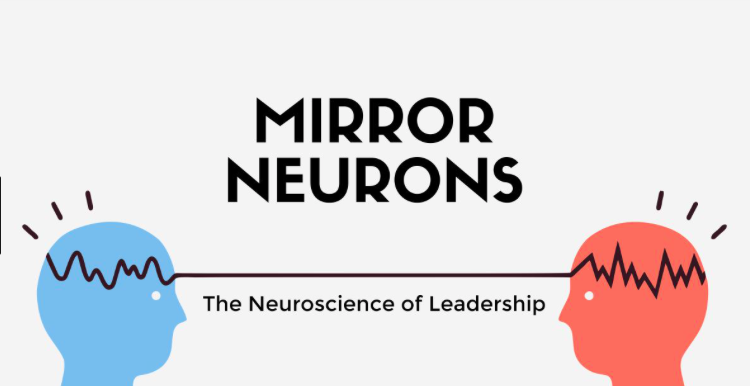 Life and its audacity for becoming like him or her… It is not only a natural trait, but a scientific fact that humans consciously or unconsciously try to imitate those who appear to be in a better position, or give a sense of superiority by their natural moves. Who doesn’t want the best job, car, house, boat, clothes, or style? Probably not many. As a philosopher, I encounter this challenging reality more problematic than beneficial. While there are good traits that humans should imitate, the ones with less flourishing future are the dominant ones. Why is this happening? Look at this video by Lupe Fiasco: ACT I “Doesn’t know the difference between right and wrong.” ACT II “Understand more the Internet than their parents” ACT III “Fruit of the confusion” Children are the most vulnerable to the effects of mirror neurons. They learn by imitating actions, phrases, and sentences. However, this doesn’t mean they cannot change as adults. In fact, as they grow, their character is mainly influence by friends and, in the modern era, Social media. In the past, cultures and societies were the main influencers in people’s character. This has been changing significantly in the past years. And I am afraid is not necessary changing for the best. Take a Plato for example, he explained hundreds of years ago how mankind easily imitates the actions of others. But he explained in sense that is not being beneficial to the people itself, as their thinking is limited and commensurate to living in a cave. Yes, a cave!!! Why would he say that? Why imitating others could be wrong? Well, it is not wrong necessarily. As I said, there are good and bad traits that humans could imitate. Yet, the ones that are less beneficial are the ones that are often imitated. So, Neurons, work in the context of what? I may have a good explanation for this, but as a scientist is hard make a claim without evidence. I don’t own my lab yet, so it is hard for me to do experiments. But let me challenge you… :) Have you ever imitated other people? How strong are your beliefs? Have you ever hold hands with a love one? Why? Now, while we know that such imitated behavior is result of mirror neurons, the fact that imitation occurs limits creativity and free thinking. Imitating others often chains the thinking. It is more complex than just desiring to have the same BMW as your neighbor. If you want it, go for it! But think about the good reasons you want it for! And not just because you felt in your gut the need of buying a BMW as well. I am not against imitating. Go for it! But imitate the good things. And question yourself why you are imitating those things. This, will enhance your brain in the growth with stronger neuro-connections. 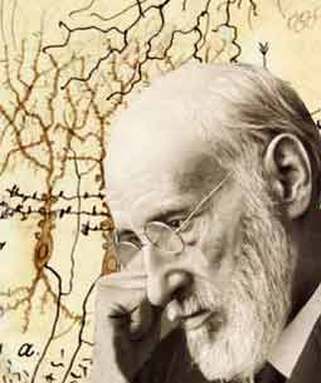
It is fascinating the new technological techniques done by scientist in these days. All investigations in particular follow a protocol of studying what has been studied, and then trying to discover something new. Although I had a good notion of how scientific research is conducted, the terminology and its definitions create an unclear environment of why science is conducted in such way. My poor connoisseurship on the field forces me to accept the protocols applied in these days, nevertheless, I looked at the old traditions of doing science and I wonder why science is conducted trough an expensive laborious way now in days. A scientist named Santiago Ramon y Cajal modified Camillo Golgi’s technique of silver nitrate. By re-impregnate the slide with silver nitrate a second time, he was able to have a clearer image of the nervous tissue and discover the neurons and its connections. This economic way of doing science placed Ramon y Cajal as the father of Neuroscience. 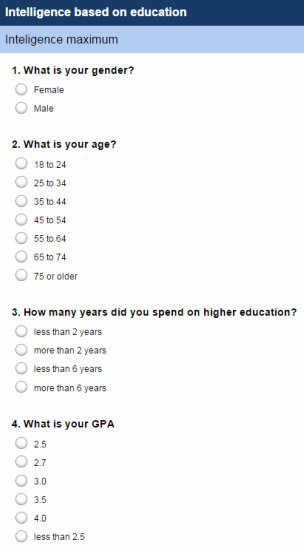 Intelligence can be interpreted differently according to what you have studied and where you have studied. Intelligence from my perspective just represents the minimum of the maximum capacity of each individual. I believe that a GPA does not reflect human’s ingenuity, nor capacity nor intelligence, instead it just reflects the quality of the imparted education. It has to be said the all humans learn differently, but in my opinion up to this time we do not how to instruct appropriately or deliver the knowledge to someone who hasn’t been taught to how receive it. However, I have no other choice but to ask common question in order to obtain a significant evidence in order to support my claim. My claim is simple, all humans count with the same brain capacity, so anyone can be the next Einstein. Through this survey I can look to facts such as Race, Age, Gender and the most important for my topic the GPA with relation of the time spent on higher education. The questions are simple, but the way I will direct the answers can be a significantly important to support my claim. Therefore, I encourage you to be part of this survey and help me support my claim. I will publish my paperwork, once I am done with it.  Up to this moment the information I’ve gathered is inconsistent. All participants come from a different ethnic background and have different outcomes.
 As undergraduate student observation has been my primary source of evidence, and through comparing and looking in detail to the educational system in the United States I have come to the conclusion that instead of fixing the educational system to improve the education in individuals they extend the academic pathway followed by a MD or PhD. And after all those discoveries that science do and new terminology is created, what would be next after PhD?
One of the most profound questions asked in the field on neuroscience is how much capacity does our human brain have to acquire knowledge, is it finite or infinite? In his book, The New Brain, Richard Restak infers that all brains are biologically homogeneous, but that performance of our brains is more related to environmental and formal stimulation. He acknowledges that stimulating our brains intellectually is the most important function in determining intellectual capacity and cognitive development. Based in part on this acknowledgement, this discussion follows the line of thought of Dr. Restak and expand on the subject of intellectual acquisition based on the primary factor of brain stimulation utilizing the most current research based on the concept of neuroplasticity and other environmental factors that contribute cognitive development. Recent research in school performance continues to show a decline in the intellectual capacity of middle and high school students, even though kids are in school an average of four days a week and study an average of 17 years before entering higher education institutions. By most accounts, the education system in the United States, to the detriment of most pedagogical research, is not producing high intellectual capacity and knowledge in high school graduates. In fact, most high school graduates lack the preparedness to successfully perform in higher education. The new Common Core Standards, developed by the Department of Education and adopted by most state governors is an attempt to revert this trend. The problem of intellectual attainment is even worse for certain minority groups. Now this is not coincidence, it is directly related to the infusion of knowledge to develop intellectual capacity. All human beings are born with the same biological brain, therefore intellectual attainment is more a fact of extensive brain stimulation in intellectual areas, and not deficiencies based on culture or race. In addition to the research conducted by Dr Restak, Nick Van Dam director and chief learning officer in global talent for Deloitte Touche Tohmatsu Limited and founder-chairman of the e-Learning for Kids Foundation, in his article “Inside the Learning Brain” provides an overall overview of improving the learning techniques by the intervention of neuroscience. Active engagement, focused attention, deployment of short learning sessions are some of the points that he explains are fundamental for a better learning. Neuroscience in conclusion, is fundamental for the better learning and creation of a better educational system model.  In technology Neuro-Networking would be a model system of programs and data structures that approximates the operation of the human brain, but this time I would like to make emphasis in the capacity that human would be able to achieve with the appropriate linking of one thought and another. The human brain is the most complex organ-machine in the world and can rapidly create synapses giving as result: Intelligence, or can slowly create those synapses giving the opposite result. Intelligence or knowledge are those linked (neurons) subjects that we learn, and that goes from the first steps to walk, up to solving a calculus problem. if humans were able to create a very complex machine like it is the computer, then that means the brain is a greater complex machine. Is important to look into the synapses between neurons to understand clearly or at least have an approximate idea of how the brain behaves. The knowledge acquired through the years is storage as information in these brain cells, the neurons. It has been said, or at least what I have heard, that neurons can be damage or die with the use of narcotics, but neurons can also die for being unused. The phrase “use your brain” has a strong meaning when we look into the science behind it, for that reason the more one use the brain the greater outcomes one will have. |
 RSS Feed